
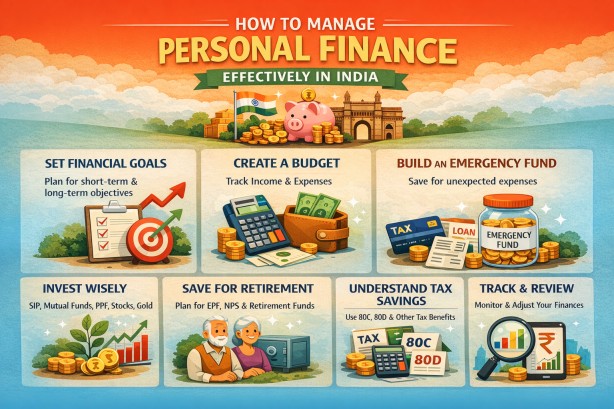
How to Manage Personal Finance Effectively in India: 2026 Guide
To manage personal finance effectively in India, follow the 50/30/20 rule: 50% for needs, 30% for wants, and 20% for savings.1 Build a 6-month emergency fund, invest in diversified SIPs, and utilize Section 80C/80D for tax savings. Leveraging UPI-integrated budgeting apps is now essential for tracking digital spending.
Why is Financial Planning Important for Indians in 2026?
The economic landscape in India has shifted significantly. With the digital payment revolution led by UPI and rising inflation affecting the cost of living, knowing how to manage personal finance effectively in India is no longer optional—it is a survival skill.
Click Here for more – How to Manage Personal Finance Effectively in India
Whether you are a Gen Z professional starting your first job in Bengaluru or a family person in Delhi, the goal remains the same: wealth creation while maintaining a safety net. Modern Indian personal finance focuses on three pillars: Discipline, Diversification, and Digital Tracking. By mastering these, you can combat “lifestyle inflation” and ensure that your money works as hard for you as you do for it.
Step 1: Mastering the 50/30/20 Budgeting Rule
The foundation of any successful financial journey starts with a budget. For Indian households, the 50/30/20 rule remains the most effective framework:
-
50% for Needs: This covers mandatory expenses such as house rent, groceries, utility bills (electricity, water, broadband), and insurance premiums.
-
30% for Wants: This is your “fun money” for dining out, weekend trips to places like Goa or Manali, OTT subscriptions, and shopping.
-
20% for Savings & Debt: This is the most critical portion. It should be automatically diverted into SIPs, Public Provident Fund (PPF), or paying off high-interest credit card debt.
Using Budgeting Apps for UPI Tracking
In 2026, manual expense tracking is nearly impossible because of the high frequency of small UPI transactions. To manage personal finance effectively in India, use apps like Walnut, Money View, or INDmoney. These apps automatically categorize your SMS alerts from banks, giving you a real-time view of where your money is going.
Step 2: Building a “Bulletproof” Emergency Fund
Before you buy your first stock or mutual fund, you must build an emergency fund. In the Indian context, where job market volatility and medical emergencies can arise suddenly, having a liquid cushion is vital.
The Golden Rule: Save at least 3 to 6 months of your monthly expenses.
-
If your monthly expenses are ₹40,000, your target should be ₹1.2 Lakh to ₹2.4 Lakh.
-
Where to keep it? Do not keep this in your regular savings account. Move it to a High-Yield Savings Account or a Liquid Mutual Fund to earn slightly higher returns while keeping the money accessible within 24 hours.
Step 3: Strategic Investing for Wealth Creation
Saving is not enough; you must invest to beat inflation, which often hovers around 6-7% in India. To manage personal finance effectively in India, your portfolio should be diversified across different asset classes.11
1. Mutual Funds via SIP
Systematic Investment Plans (SIPs) are the best tool for long-term wealth. For beginners, Index Funds (tracking the Nifty 50) are a low-cost way to grow with the Indian economy. Aim for a 12-15% CAGR over 10+ years.
2. Public Provident Fund (PPF)
For risk-averse individuals, PPF is a “must-have.” It offers a sovereign guarantee, a decent interest rate (currently around 7.1%), and falls under the EEE (Exempt-Exempt-Exempt) tax category, meaning the investment, interest, and maturity are all tax-free.
3. Direct Equity and Gold
If you have a higher risk appetite, allocating 10-15% of your portfolio to direct stocks can boost returns. Additionally, Sovereign Gold Bonds (SGB) remain the smartest way for Indians to invest in gold, offering a 2.5% annual interest on top of the gold price appreciation.
Step 4: Tax Planning under New vs. Old Regime
Efficient tax planning is like getting a guaranteed return on your money. As of the FY 2025-26 budget, the New Tax Regime has become the default choice for many due to lower slab rates and an increased standard deduction of ₹75,000.
| Section | Investment Type | Maximum Deduction |
| 80C | PPF, ELSS, EPF, Life Insurance | ₹1.5 Lakh |
| 80D | Health Insurance Premiums | ₹25,000 (Self) / ₹50,000 (Senior Parents) |
| 24(b) | Home Loan Interest | Up to ₹2 Lakh |
| 80CCD(1B) | National Pension System (NPS) | Additional ₹50,000 |
To manage personal finance effectively in India, compare both regimes. If you have a home loan and significant 80C investments, the Old Regime might still save you more money.
Step 5: Essential Insurance Coverage
One medical bill can wipe out years of savings. In 2026, with medical inflation rising at 10-15% in India, insurance is your biggest financial asset.
-
Health Insurance: Buy a private health cover of at least ₹10 Lakh for your family, even if your employer provides one. Employer covers often end when you switch jobs.
-
Term Life Insurance: If you have dependents, a pure Term Insurance policy is mandatory. The sum assured should be 10 to 15 times your annual income. Avoid “Endowment” or “Money-back” plans as they offer low returns and low insurance cover.
Step 6: Debt Management (The Avalanche vs. Snowball Method)
High-interest debt, like credit cards (charging 36-42% interest), is a “wealth killer.”
-
Avalanche Method: Pay off the debt with the highest interest rate first. This saves the most money in the long run.
- Snowball Method: Pay off the smallest debt first for a psychological win.
Choose the method that keeps you motivated, but prioritize clearing credit card dues immediately.
Conclusion: Start Today for a Secure Tomorrow
Learning how to manage personal finance effectively in India is a marathon, not a sprint. Start by tracking your expenses this week, setting up an SIP, and ensuring your family is covered by health insurance. Small, disciplined steps in 2026 will lead to total financial freedom by 2035.
Stay tuned to My Finance Money for more investing and financial updates tailored for the modern Indian!
FAQ: Frequently Asked Questions on Indian Personal Finance
1. What is the best way to start investing for a beginner in India?
The best way is to start a Monthly SIP in a Nifty 50 Index Fund. It is low-cost, diversified, and requires no deep market knowledge.
2. How much should I save in my emergency fund?
You should aim to save 3 to 6 months of your essential monthly expenses.22 For example, if you spend ₹50,000 a month, your fund should be ₹1.5 Lakh to ₹3 Lakh.
3. Is the New Tax Regime better than the Old Regime in 2026?
It depends on your deductions. The New Regime is generally better for those with fewer investments (80C, HRA). The Old Regime is better if you have a home loan and maximize Section 80C and 80D.23
4. Should I buy Gold in 2026 for investment?
Yes, but avoid physical gold. Sovereign Gold Bonds (SGB) are better because they pay 2.5% annual interest and are tax-free if held until maturity.
5. Which app is best for tracking UPI expenses in India?
Apps like Walnut, INDmoney, and Money View are excellent for automatically tracking and categorizing your digital spending via SMS alerts.
1 thought on “How to Manage Personal Finance Effectively in India”