
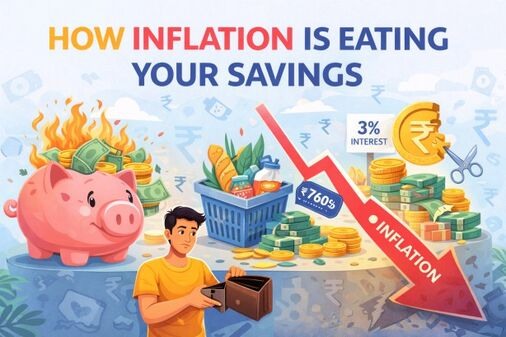
Many people believe that keeping money in a savings account is the safest financial decision. However, very few understand the real inflation impact on savings. Inflation silently reduces the value of your money over time, making your savings less powerful than you think.
If your income is not growing faster than inflation, your purchasing power is actually shrinking. Understanding the inflation impact on savings is crucial for long-term financial stability.
What Is Inflation?
Inflation is the rate at which the prices of goods and services increase over time. When inflation rises, the cost of living increases. This directly affects your daily expenses like groceries, fuel, rent, and healthcare.
For example, if inflation is 6% per year, something that costs ₹100 today may cost ₹106 next year. This is where the inflation impact on savings becomes dangerous—your money loses value if it doesn’t grow at the same rate.
How Inflation Reduces Purchasing Power
Purchasing power refers to what your money can buy. The biggest inflation impact on savings is the reduction in purchasing power.
Let’s understand with an example:
-
You save ₹1,00,000 in a bank account earning 3% interest.
-
Inflation rate is 6%.
-
Your real return is actually negative 3%.
This means your savings are growing slower than prices, making you poorer in real terms.
Why Keeping Money in Savings Account Is Not Enough
Many Indians prefer keeping money in traditional savings accounts or fixed deposits. While these are safe, they often fail to beat inflation. The long-term inflation impact on savings can significantly reduce wealth if money is not invested properly.
Low-interest savings instruments may:
-
Provide safety
-
Offer liquidity
-
But fail to protect against rising prices
Without inflation-beating returns, your savings gradually lose strength.
Long-Term Inflation Impact on Savings
Over 10–20 years, inflation can drastically reduce the real value of money. The inflation impact on savings becomes more visible during long-term goals like:
-
Retirement planning
-
Child education
-
Buying a house
-
Healthcare planning
If inflation averages 5–7% annually, money kept idle loses a major portion of its real value over decades.
Read for more blog – best savings account India
How to Protect Your Savings From Inflation
To reduce the inflation impact on savings, consider these strategies:
1. Invest in Inflation-Beating Assets
Equity mutual funds and stocks historically provide returns higher than inflation over the long term.
2. Diversify Your Portfolio
Don’t keep all money in savings accounts. Balance between fixed income and growth investments.
3. Increase Income Regularly
Upskilling and career growth help maintain purchasing power.
4. Review Financial Goals
Adjust your goals considering inflation projections.
5. Use SIP (Systematic Investment Plan)
SIPs help create wealth gradually and counter the inflation impact on savings effectively.
Inflation vs Interest Rate: Understanding the Difference
Many people confuse bank interest with real returns. If inflation is higher than your interest rate, your real return becomes negative. The inflation impact on savings is always calculated after subtracting inflation from your earnings.
Real Return = Interest Rate – Inflation Rate
If the result is negative, your savings are losing value.
Why Financial Awareness Is Important
Financial literacy helps you understand how inflation works. The inflation impact on savings is not immediately visible, which is why many people ignore it. But over time, it can severely affect financial freedom.
Being proactive today ensures stronger financial security tomorrow.
FAQ:
1. What is the inflation impact on savings?
It refers to the reduction in purchasing power of your saved money due to rising prices over time.
2. Can savings accounts beat inflation?
Generally, traditional savings accounts do not offer returns high enough to beat inflation consistently.
3. How can I protect my money from inflation?
Investing in assets like mutual funds, stocks, or inflation-protected instruments can help.
4. Is fixed deposit safe from inflation?
Fixed deposits are safe but may not always provide inflation-adjusted returns.
5. Why is inflation dangerous for long-term savings?
Because it reduces the real value of money over time, affecting major financial goals.
6. Should I stop saving because of inflation?
No, you should save—but also invest wisely to reduce the inflation impact.